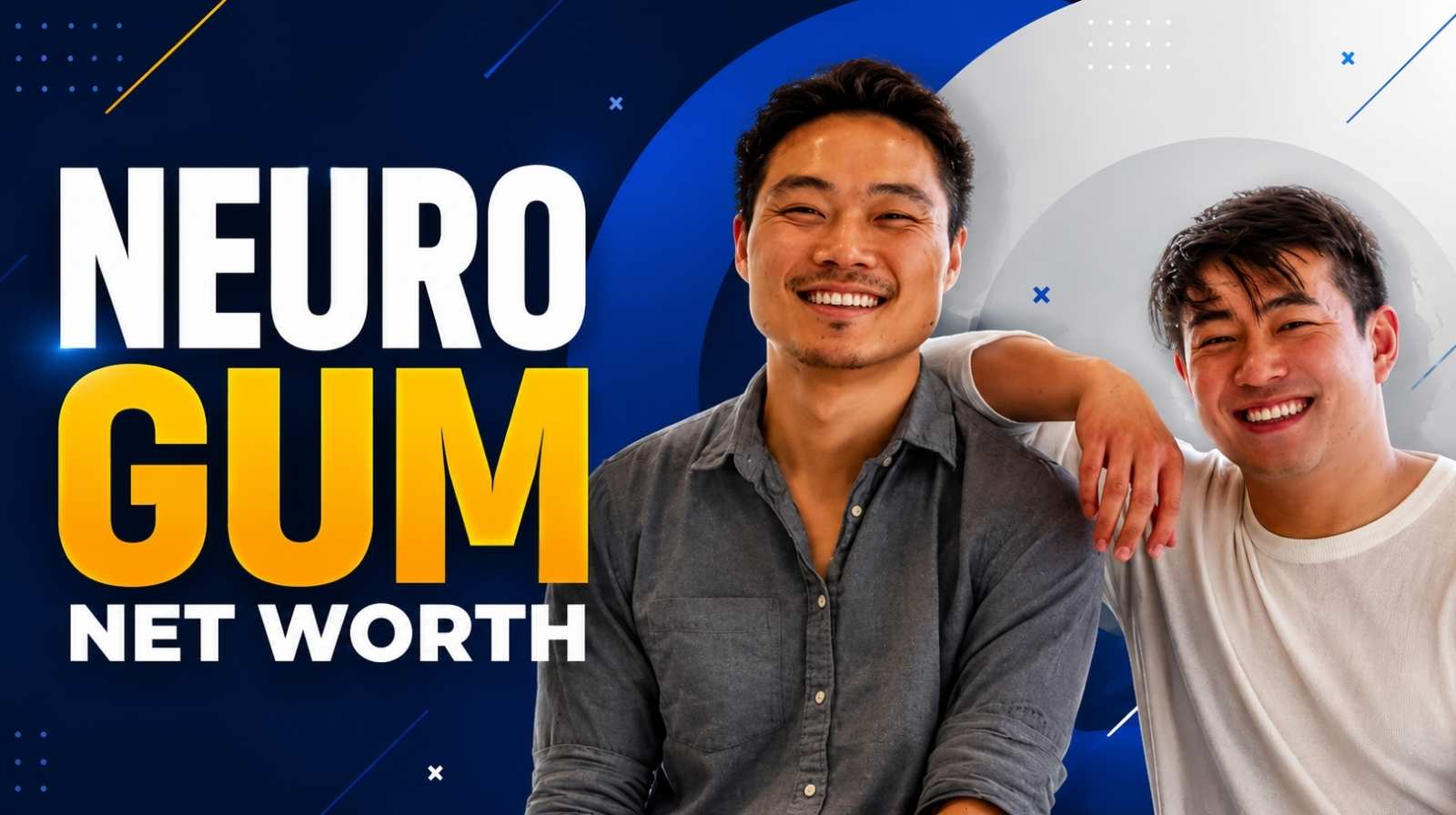

Two college athletes walked off the Shark Tank stage in 2020 without a dime of investment. Most viewers assumed that was the end of the story. It wasn’t. Neuro Gum, the caffeinated nootropic gum brand founded by Kent Yoshimura and Ryan Chen, turned that rejection into one of the most talked-about bootstrapped growth stories in functional wellness.
Today, Neuro sits in more than 20,000 retail locations, has sold hundreds of millions of pieces of gum and mints, and carries a valuation firmly in nine-figure territory. This article breaks down the real Neuro Gum net worth in 2026, revenue milestones, the full Shark Tank story (including a surprising second appearance), the trademark lawsuit that nearly ended the brand, and where the company is headed next.
Current Neuro Gum Net Worth and Valuation in 2026
Most credible estimates place Neuro Gum’s net worth in 2026 between $80 million and $150 million, with several analysts converging around the $100 million mark. That figure isn’t a guess pulled from thin air; it’s grounded in documented milestones: confirmed retail expansion, a completed seed raise, strong e-commerce numbers, and a growing subscription base.
A few things separate this valuation from typical startup hype. The company reached eight-figure annual revenue years ago and has kept growing since. Retail distribution expanded from a few thousand doors to over 20,000 stores nationwide. The brand secured a strategic partnership with Daniel Lubetzky, founder of KIND Snacks, who later became an official Neuro partner. And Neuro returned to Shark Tank in Season 17 and actually closed a deal, making it the first company in the show’s history to reject an offer on one appearance and accept one on a later visit.
Because Neuro remains privately held, there’s no audited public valuation. Estimates vary depending on the revenue multiple analysts apply, which is standard for a fast-growing consumer packaged goods brand in an emerging category like functional nootropic gum.
Revenue Performance and Financial Milestones
Neuro’s revenue climb has been steady rather than accidental:
- 2018: Roughly $1.5 million in annual turnover.
- 2019: Revenue nearly doubled to around $3.5 million, the same year co-founder Ryan Chen was named to the Forbes 30 Under 30 list.
- 2020 to 2022: Crossed into eight-figure annual revenue as retail and e-commerce channels scaled together.
- 2023: An $8.3 million seed round closed, funding supply chain and marketing without sacrificing founder control.
- 2024 to 2026: TikTok Shop alone reportedly generated several million dollars a month at peak performance, while retail distribution passed 20,000 stores.
Multiple revenue streams now support the business: direct-to-consumer sales, wholesale orders from major retailers, Amazon, TikTok Shop, a subscription program, and a growing B2B channel where companies buy gum in bulk for employee wellness programs. A brand earning from six channels at once is far more durable, and far more attractive to a potential acquirer, than one relying on a single revenue source.
Neuro Gum Shark Tank Journey and Investment Details
Kent Yoshimura and Ryan Chen appeared on Shark Tank Season 11, Episode 19, which aired in early 2020. They asked for $750,000 in exchange for 5% equity, implying a $15 million valuation at the time. Two Sharks made offers: Kevin O’Leary offered $750,000 for 5% equity with a $0.50 per-unit royalty until he recouped $1 million, and Robert Herjavec offered $1 million for 20% equity. Both came with real trade-offs; O’Leary’s royalty would have squeezed margins on every unit, and Herjavec’s offer meant giving up a fifth of the company. Kent and Ryan turned both down and walked out without a deal.
Post-Shark Tank Success Matrix
| Metric | Before Shark Tank | After Shark Tank |
| Website traffic | Baseline | Surged as much as 400% within 48 hours of airing |
| Social following | Around 5,000 | Jumped toward 50,000 shortly after |
| Customer acquisition cost | Standard paid marketing cost | Dropped an estimated 60 to 65% |
| Retail interest | Founder-driven outreach | Retailers began approaching the brand directly |
| Media coverage | Limited | Featured in Forbes, Entrepreneur, and Business Insider |
The exposure alone functioned like a free national ad campaign. Combined with an organic Joe Rogan podcast mention that reportedly sent site traffic up 20 times overnight, Neuro’s brand awareness snowballed in a way no single Shark’s check could have replicated.
The story doesn’t stop there. Neuro returned to Shark Tank in Season 17, Episode 13, which aired March 11, 2026, as part of an update segment, by which point the company was already distributed in more than 20,000 stores. This made Neuro the first company in Shark Tank history to decline an offer on one episode and secure investment on a later one, a milestone that adds real weight to the founders’ original decision to walk away.
Background of Founders and Neuro Gum Net Worth Impact
Kent Yoshimura and Ryan Chen met while studying at the University of California, San Diego. Yoshimura studied neuroscience, and Chen studied chemistry. Both were serious athletes outside the classroom, which shaped how they approached building a company from scratch.
Kent Yoshimura serves as CEO, leading product vision, brand direction, and marketing. Before Neuro, he trained for the Japanese Judo team and competed internationally in Muay Thai, a competitive discipline that carried directly into his approach to entrepreneurship.
Ryan Chen serves as CFO, overseeing financial operations and supply chain. Chen suffered a spinal cord injury after a snowboarding accident, which left him unable to walk. That experience shaped Neuro’s founding mission: creating a product that offered clean, portable energy without requiring someone to mix powders or open bottles.
Their combined personal net worth is generally estimated between $15 million and $40 million as of 2026, reflecting their retained majority equity in the company. Because they never gave up meaningful ownership on Shark Tank, both founders captured nearly all the upside as the company’s value climbed.
Read More: Jodi Arias Net Worth 2026: Inside Her Income, Prison Life & Art Sales
Company Founding Story and Vision
Neuro launched in 2015 out of a simple frustration. Energy drinks were loaded with sugar and artificial ingredients. Coffee wasn’t always practical to carry around. Pills felt clinical and were awkward to share or take discreetly. Yoshimura and Chen wanted something clean, fast-acting, and genuinely portable.
They began experimenting with nootropic formulations during college, mixing compounds aimed at improving focus without the jittery crash associated with typical energy products. The idea to deliver those ingredients through gum reportedly clicked during a scuba diving trip, when the founders realized gum was more socially acceptable to share in public than swallowing a pill.
In 2015, they launched an Indiegogo crowdfunding campaign with a modest $10,000 goal. It hit that target within three days and ultimately raised around $21,000, enough to fund their first production run of roughly 4,500 pounds of gum, stored in a cramped space that founders still reference today.
Neuro Gum Lawsuit
Not long after the Shark Tank episode aired, Neuro faced a serious legal threat. Neurobrands, LLC filed a trademark lawsuit against Neurogum, Inc. in April 2020 in the U.S. District Court for the Central District of California, disputing rights connected to the “Neuro” brand name.
According to the founders, legal fees alone were enough to threaten the company’s survival, even though they were confident in their position. Facing a well-funded plaintiff, Ryan Chen reached out directly to Daniel Lubetzky, founder of KIND Snacks and a former Shark Tank guest judge who had faced similar trademark battles of his own.
Lubetzky stepped in to help navigate the dispute, staying involved in negotiations until the parties reached a settlement. Court records show the case was formally terminated in November 2021. Years later, in 2026, Lubetzky officially became a partner in Neuro, turning a legal rescue into a long-term strategic alliance. It’s a reminder that the brand’s growth wasn’t a straight line: a near-death legal battle hit right as the company tried to capitalize on its Shark Tank momentum.
Read More: Billy Lane Net Worth 2026: How Prison Changed His Fortune Forever
Neuro Gum Owner
Neuro Gum is privately owned and operated by its two co-founders, Kent Yoshimura and Ryan Chen, who together hold majority equity. Because they declined the Shark Tank offers in 2020, no outside investor took a meaningful ownership stake at that stage.
The ownership picture has evolved gradually rather than through one large funding event. Key developments include an $8.3 million seed round completed in 2023 that brought in capital without ceding control, strategic involvement from musician and entrepreneur Steve Aoki starting in late 2024, backing described as coming from a Fortune 100 company, Daniel Lubetzky’s formal partnership role (which began as legal support during the trademark lawsuit), and a confirmed investment deal secured during the Season 17 Shark Tank update episode in 2026.
Despite these additions, Yoshimura and Chen have retained primary control of the brand’s direction, a significant factor supporting the high valuation estimates, since investors tend to view founder-led majority ownership favorably.
Neuro Gum Shark Tank Offer
To recap the specific numbers from the original pitch, since this detail gets asked about constantly: the founders requested $750,000 for 5% equity, valuing the company at $15 million. Kevin O’Leary countered with $750,000 for 5% equity plus a $0.50 royalty on every unit until he recovered $1 million, while Robert Herjavec countered with $1 million for 20% equity. Final outcome on Season 11: no deal.
It’s worth debunking a persistent rumor here. A viral, edited TikTok video circulated claiming Mark Cuban offered $30 million for Neuro Gum. That claim is false, stemming from a manipulated video that spliced together unrelated segments. Cuban was not one of the two Sharks who made an offer to Neuro. The real offer, when Neuro finally accepted one, came years later on the Season 17 update episode in 2026, at which point the company’s leverage, revenue, and retail footprint were dramatically stronger than in 2020.
Product Innovation and Market Status
Neuro’s original flagship product, Energy & Focus gum, launched in 2015 with a formula built around natural caffeine, L-theanine, and B vitamins, designed to deliver alertness without the jittery spike and crash associated with energy drinks.
The product lineup has expanded well beyond that original formula:
- Energy & Focus, the original caffeinated gum
- Calm & Clarity, aimed at stress reduction and mental clarity
- Sleep & Recharge, formulated for pre-sleep relaxation
- Memory & Focus, targeting cognitive performance
Every product is sugar-free, gluten-free, vegan, and free of aspartame, manufactured using a patented cold-compression process the company says preserves ingredient potency better than heat-based methods common in competing gummies. In 2025, Neuro released a Strawberry Cake flavor developed with Steve Aoki, and the brand was named the second fastest-growing company in Las Vegas on the Inc. 5000 list for 2025, with the co-founders receiving Ernst & Young’s Entrepreneur of the Year 2025 Pacific Southwest Award.
Sales Channel and Distribution Strategy
Retail Presence
Neuro’s retail footprint has expanded dramatically since the Shark Tank episode aired. The brand is now sold in more than 20,000 locations across the United States, including CVS Pharmacy, Walmart, Target, GNC, Whole Foods Market, Vitamin Shoppe, and Walgreens. Landing shelf space at chains like these required more than a good product; it required proof of consistent demand, which the brand built through direct-to-consumer sales and social traction before major retailers came calling.
Digital Marketing Success
Neuro’s digital growth is just as important as its retail wins. The founders leaned into organic content rather than expensive paid campaigns, particularly on TikTok, where Kent Yoshimura reportedly posted daily for a full year without an agency. That effort built a creator community, sometimes cited at around 25,000 contributors, who now generate content for the brand and receive payouts collectively worth a significant sum each month. TikTok Shop alone has reportedly generated several million dollars in monthly sales at peak periods. The brand also benefited from organic celebrity mentions, most notably from Joe Rogan, whose podcast reference sent website traffic surging without any paid sponsorship involved.
Read More: 950+ Best Harry Potter WiFi Names: Funny, Cool & Magical Network Ideas
Manufacturing and Supply Chain Excellence
Ryan Chen’s operational background shows up clearly in how efficiently Neuro manufactures and distributes its products. A single pack of gum retails for around $3.99 and reportedly costs roughly $0.67 to produce, a margin structure that supports healthy profitability across both retail and direct-to-consumer channels.
The cold-compression manufacturing process is central to product claims, designed to preserve the potency of caffeine and other active ingredients better than heat-based methods used by many competing supplement gummies. Maintaining consistency at scale, from a few thousand pounds of gum in storage to hundreds of millions of units sold cumulatively, has been a genuine operational achievement, and it also supports the subscription program’s need for predictable, reliable fulfillment.
Investment Analysis and Future Estimates
Valuation Methodology Factors
Analysts estimating Neuro’s worth typically weigh several factors: trailing twelve-month revenue and growth rate, comparable revenue multiples used for high-growth CPG and wellness brands (often cited in the 8x to 12x range), retail distribution breadth, direct-to-consumer and subscription revenue stability, brand equity built through media coverage and organic social reach, and founder equity retention, which signals long-term alignment with company performance.
Growth Drivers
Several forces continue pushing Neuro’s valuation upward heading into the back half of the decade.
Primary Growth Catalysts
- International expansion into markets like Canada, the United Kingdom, and Australia
- Continued growth of the subscription model, which improves revenue predictability
- Expansion of B2B corporate wellness partnerships
- New product launches extending the brand beyond energy into sleep, calm, and memory categories
- Sustained TikTok Shop and Amazon marketplace performance
- Potential acquisition interest from larger CPG conglomerates
If current growth trends hold, some analysts project Neuro’s valuation could reach $200 million to $300 million within the next couple of years, particularly if international markets scale the way domestic retail did.
FAQ’s
What is Neuro Gum’s net worth in 2026?
Most estimates place Neuro Gum’s net worth between $80 million and $150 million in 2026, with many analysts converging around the $100 million mark based on revenue and retail growth.
Did Neuro Gum get a deal on Shark Tank?
Not on their original Season 11 appearance in 2020, when they declined offers from both Kevin O’Leary and Robert Herjavec. They did secure a deal during a later update appearance on Season 17 in 2026.
Who owns Neuro Gum?
Co-founders Kent Yoshimura and Ryan Chen own and operate Neuro Gum, retaining majority equity after declining outside investment on their first Shark Tank appearance.
What caused the Neuro Gum lawsuit?
Neurobrands, LLC filed a trademark lawsuit against Neurogum, Inc. in April 2020. The case was eventually settled with help from KIND Snacks founder Daniel Lubetzky and was formally closed in late 2021.
What ingredients are in Neuro Gum?
Neuro Gum contains natural caffeine, L-theanine, and B vitamins, and is formulated to be sugar-free, gluten-free, vegan, and aspartame-free.
Where can I buy Neuro Gum?
Neuro Gum is available at major retailers including CVS, Walmart, Target, Whole Foods, Walgreens, GNC, and Vitamin Shoppe, plus online through Amazon, TikTok Shop, and the official Neuro website.
How much is Kent Yoshimura and Ryan Chen’s personal net worth?
The founders’ combined personal net worth is generally estimated between $15 million and $40 million in 2026, based on their retained equity stake in the company.
Conclusion
Neuro Gum’s rise from a $21,000 Indiegogo campaign to a company valued as high as $150 million is a rare startup story, one where walking away from money on national television turned out to be the smartest financial decision the founders ever made. Kent Yoshimura and Ryan Chen didn’t just survive a Shark Tank rejection and a nearly company-ending lawsuit; they used both moments to build something more durable, a brand with genuine retail distribution, loyal digital customers, and equity that stayed almost entirely in their own hands.
Whether Neuro reaches the $200 million range some analysts project depends on how international expansion and subscription growth perform over the next few years. Given the track record so far, betting against Kent and Ryan has not been a winning strategy.

Yousaf is a dedicated content professional with 7 years of experience in digital publishing and entertainment media. Specializing in celebrity blogs, he creates engaging, well-researched, and up-to-date content that keeps readers informed and entertained. His expertise in spotting trending stories, maintaining editorial quality, and delivering reliable celebrity news makes him a valuable administrator for the website.