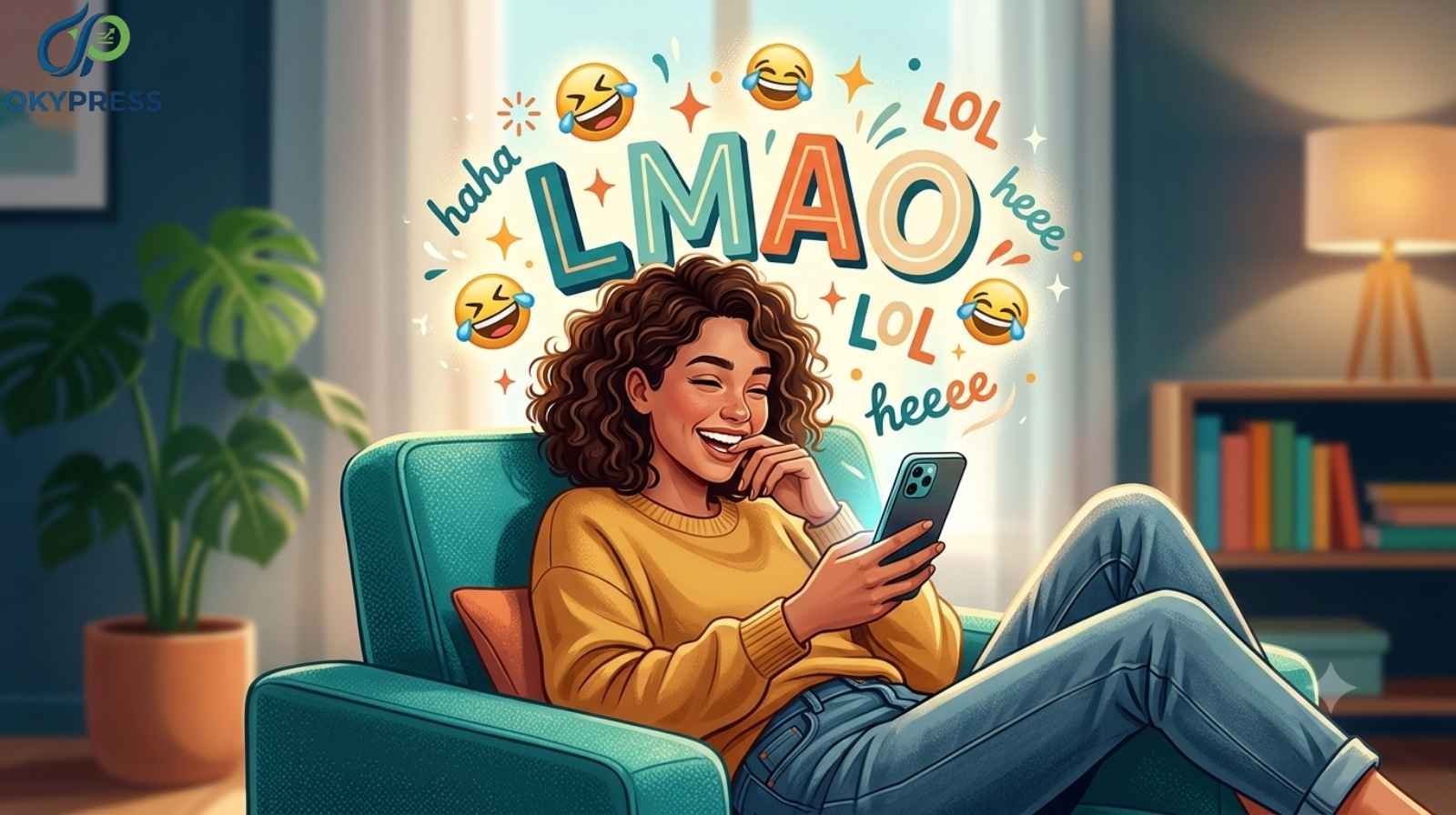

You get a text back. It just says “LMAO.” No sentence, no punctuation, nothing else. Are they actually laughing? Being polite? Brushing you off?
If you have ever paused over a message like that, you are not overthinking it. LMAO is one of the most-used pieces of internet slang, yet its tone shifts depending on who sends it, where it shows up, and how many extra letters get tacked on the end. This guide breaks down exactly what LMAO means, where it came from, how people use it across platforms in 2026, and how to reply without sounding awkward.
Definition & Meaning
LMAO stands for “Laughing My Ass Off.” It is an internet acronym used to show that something is genuinely, strongly funny, more intense than a casual “lol” but usually less over-the-top than “ROFL” (rolling on the floor laughing).
Think of it as a laughter scale:
- Haha – mild, polite amusement
- LOL – a real chuckle
- LMAO – something actually cracked you up
- ROFL / LMFAO – full-blown, can’t-breathe laughter
LMAO sits in the middle to upper end of that scale. It is informal, playful, and almost never used outside of texting, chat apps, and social media comment sections.
How It’s Used
In practice, LMAO shows up in a few common ways:
- As a direct reaction to something funny someone said or sent
- As a comment under a meme, video, or funny post
- As a soft cushion at the end of an awkward or self-deprecating story
- Stretched out for emphasis, like “lmaooo” or “LMAOOOO”
That third use is worth pausing on, because most guides skip it. People often type LMAO after admitting something mildly embarrassing, not because it is hilarious, but to soften the moment. “I forgot I had a meeting today lmao” is not really a joke. It is a way of saying “don’t judge me too hard,” similar to a nervous laugh in a face-to-face conversation.
Background & History
Origins
The idea behind LMAO is older than the internet itself. The phrase “laughing my ass off” was already part of casual American English by the mid-20th century. It even appears in a milder form in J.D. Salinger’s 1951 novel The Catcher in the Rye, where the narrator describes a scene that has everyone at a table laughing uncontrollably.
The acronym itself took shape in early online spaces, chat rooms, bulletin board systems, and multiplayer text games of the 1990s, where typing speed mattered and users needed short, punchy ways to express reactions. LMAO joined LOL and ROFL as part of the first wave of true internet shorthand.
Growth Through Social Media
As instant messaging, then texting, then platforms like Twitter, Facebook, and later Instagram and TikTok took over daily communication, LMAO moved with it. Character limits, fast-scrolling feeds, and comment culture all rewarded short reactions over full sentences. LMAO became a default way to signal “this is funny” without slowing down to type anything more.
By the 2010s, it had become so common that it barely registered as slang anymore in casual spaces, similar to how “OK” stopped feeling like an abbreviation generations ago.
Read More: Matty Cardarople Net Worth 2026: Inside His Income, Acting Career & Success Story
LMAO in 2026
Today, LMAO is still everywhere, but its usage has diversified:
- Stylistic stretching is common: lmaoo, lmaooo, and LMAOOOO all signal increasing amusement.
- Case matters socially. Lowercase “lmao” tends to read as relaxed and low-key, while all-caps LMAO can feel more theatrical or excited.
- Companion phrases have grown around it, like “lmao fr” (for real) or “lmao no cap” (genuinely, not exaggerating).
- AI chat assistants and voice-to-text tools now recognize and auto-suggest LMAO, which has cemented it as standard digital vocabulary rather than niche slang.
The core meaning has not changed much in three decades. What has changed is how much emotional nuance people pack into it.
Usage in Different Contexts
LMAO does not mean exactly the same thing in every setting. Context changes its weight:
| Context | Typical Meaning |
| Reply to a joke or meme | Genuine amusement |
| End of an embarrassing story | Social cushioning, not real laughter |
| Comment on viral content | Quick, low-effort engagement |
| Gaming chat / Discord | Reaction to a funny fail or clutch moment |
| Group chat filler | Acknowledgment, keeping the conversation alive |
Key Takeaway
LMAO almost always signals amusement or friendliness, but it can also work as verbal filler, a way to soften bad news, or a low-effort way to keep a conversation moving. Reading the surrounding message matters more than the acronym itself.
Suitability for Professional Communication
When It’s Okay
LMAO can work in relaxed, informal workplace chats, especially in casual company cultures that use tools like Slack for everyday banter. A quick “that meeting ran an hour over, lmao” between coworkers who already text informally is generally harmless.
When to Avoid
Skip LMAO in:
- Client-facing emails
- Formal reports, proposals, or academic writing
- First-time professional introductions
- Any message where tone needs to read as polished or serious
The word “ass” inside the acronym is mild profanity in many regions, which is reason enough to leave it out of anything formal. Safer professional alternatives include “that’s hilarious,” “I couldn’t stop laughing,” or a simple “😂” where emoji are already accepted in the workplace.
Hidden or Offensive Meanings
For the vast majority of conversations, LMAO simply means strong laughter. There is no secret or coded meaning behind it in mainstream use.
That said, a few nuances are worth knowing:
- Because it contains “ass,” some people and platforms treat it as mild profanity, which is why school or workplace filters occasionally flag it.
- Sarcastic or dark uses exist in certain online subcultures, where LMAO gets tacked onto something upsetting rather than funny, similar to nervous laughter used to deflect discomfort. This is not the standard meaning, but it explains why an LMAO attached to bad news can feel jarring rather than joyful.
- LMFAO, the more intense cousin of LMAO, swaps in a stronger swear word and should be treated as more explicit and less appropriate for younger audiences or mixed company.
If a message pairs LMAO with something that is not actually funny, it is usually a sign the sender is deflecting or downplaying, not an indication of a hidden slang meaning.
Read More: Ivan Cornejo Height Revealed: Fans Shocked by Singer’s Real Stats
Usage in Online Communities & Dating Apps
Social Media
On platforms like TikTok, Instagram, and X, LMAO functions as instant social currency in comment sections. “LMAO I can’t 😭” or “this sent me lmao” are everywhere under viral clips and memes. Creators and brands lean on it too, since a caption like “when the shoot goes wrong LMAO” reads as relatable rather than scripted.
On Reddit and Discord, it is used constantly and almost neutrally, especially in gaming communities reacting to funny clips, fails, or clutch plays in real time.
Dating Apps
On Tinder, Bumble, and Hinge, LMAO carries a specific social job: signaling that you are relaxed, playful, and not taking the conversation too seriously. A reply like “your bio is so chaotic lmao, I love it” reads as warm and low-pressure, which tends to land well early in a match.
The catch is overuse. Dropping LMAO after every single message can come across as low-effort or disengaged rather than genuinely amused, since it starts to look like a placeholder instead of a real reaction. Save it for moments that actually earn it.
Comparison with Similar Terms
| Term | Meaning | Intensity |
| LOL | Laughing out loud | Mild |
| LMAO | Laughing my ass off | Medium-high |
| LMFAO | Laughing my (expletive) ass off | High, more explicit |
| ROFL | Rolling on the floor laughing | High |
| LMBO | Laughing my butt off | Medium, family-friendly |
10 Slang Terms & Acronyms Containing “LMAO”
- LMAOO / LMAOOOO – stretched spelling for extra comedic effect
- LMAO fr – “laughing my ass off, for real,” adds sincerity
- LMAO no cap – genuinely funny, no exaggeration
- LMAOO ded – paired with “dead” or the skull emoji to mean extreme laughter
- LMAOO stop – used when something is so funny it feels like too much
- LMFAO – a stronger, more explicit version of LMAO
- LMBO – “laughing my butt off,” a softer, family-friendly alternative
- LMTO – an older variant meaning “laughing my tush off”
- LMAO bro – casual, common in male-to-male texting and gaming chats
- LMAOO ong – “laughing my ass off, on god,” a Gen Z intensifier meaning “I swear this is true and funny”
How to Respond
Casual Responses
- “lol same”
- “haha true”
- “lmaoo right”
Funny Responses
- “I’m actually crying 💀”
- “not you doing this again lmaooo”
- “screaming”
Professional / Polite Alternatives
- “That’s hilarious!”
- “Ha, good one.”
- “I couldn’t help but laugh at that.”
Privacy-Friendly / Neutral
- A simple “😄” or “😂” emoji
- “That’s funny”
- A short “haha” if you want warmth without full slang
Regional & Cultural Differences
LMAO originated in American internet culture, and its casualness reflects that. In the United States and Canada, it is treated as everyday texting language across most age groups under 50.
In the UK and Australia, LMAO is understood and used, but “haha,” “lol,” and locally flavored slang like “dead” or “cracking up” often show up alongside or instead of it in casual chats.
In many parts of Asia and Europe, LMAO is widely recognized among younger, internet-fluent users thanks to global social media, but it is more likely to appear in English-language conversations than in native-language texting, where local laughter expressions (like “wwww” in Japanese internet slang or “kkk” in Brazilian Portuguese) often take its place.
Because the acronym contains a body-part reference some cultures consider mildly crude, it tends to stay within peer-to-peer, informal messaging rather than crossing into formal or intergenerational communication almost anywhere in the world.
FAQ’s
What does LMAO mean in a text from a girl?
It means the same thing regardless of who sends it: strong amusement. Context and tone, not gender, determine whether it is genuine laughter or a friendly conversational cushion.
Is LMAO rude or offensive?
Not typically. It contains mild profanity (“ass”), so it is best avoided in formal or professional settings, but it is not considered offensive in casual conversation.
What is the difference between LOL and LMAO?
LOL signals mild amusement, while LMAO expresses stronger, more genuine laughter at something you found hilarious.
Is LMFAO worse than LMAO?
Yes. LMFAO includes a stronger swear word, making it more explicit and less suitable for younger audiences or professional settings.
Can I use LMAO in a work chat?
Only in casual, relaxed workplace cultures with coworkers you already text informally. Avoid it in emails, client communication, or formal documents.
Does LMAO always mean something is funny?
Not always. It is sometimes used to soften embarrassing admissions or awkward moments, acting more like a social cushion than literal laughter.
What does it mean when someone only replies “LMAO”?
It usually means they found your message funny but did not have much else to add. It is a low-effort but friendly acknowledgment, not a sign of disinterest on its own.
Is LMAO used the same way worldwide?
It is widely understood globally thanks to English-language social media, but usage is heaviest in the US, Canada, UK, and Australia, with other regions often mixing it with local laughter slang.
Conclusion
LMAO has stuck around for decades because it does something simple very well: it lets people express real laughter in three or four keystrokes. Whether it shows up in a meme comment, a dating app opener, or a group chat, the acronym still means the same core thing it always has, “laughing my ass off,” even as the ways people use it keep evolving.
The next time someone sends you a lone “LMAO,” you will know exactly how to read it, and exactly how to text back.

Yousaf is a dedicated content professional with 7 years of experience in digital publishing and entertainment media. Specializing in celebrity blogs, he creates engaging, well-researched, and up-to-date content that keeps readers informed and entertained. His expertise in spotting trending stories, maintaining editorial quality, and delivering reliable celebrity news makes him a valuable administrator for the website.